MeshCore Packet Structure
HEADER · ROUTE · PATH · PAYLOAD · REGION SCOPE
Every MeshCore packet consists of a one-byte header, optionally four bytes of transport codes, a path byte, the path itself, and the payload. The LoRa chip adds the preamble, sync word, and CRC around all of that; the MeshCore firmware never sees those and processes only the part described below.
[!NOTE] Source. This page has been verified against the firmware itself:
MeshCorev1.16.0, commita3a1aa5, 19 July 2026 — filessrc/Packet.h,src/Packet.cpp,src/Dispatcher.cpp,src/Mesh.cpp,src/helpers/RegionMap.cpp,src/helpers/TransportKeyStore.cpp, and the officialdocs/packet_format.mdanddocs/payloads.md.
Two layers: what is LoRa, what is MeshCore
A transmission consists of two layers that stand apart from each other. The radio chip builds its own frame; MeshCore supplies only the contents of it. That distinction is the key to the rest of this page: several fields that look like MeshCore fields at first glance belong to the radio chip.
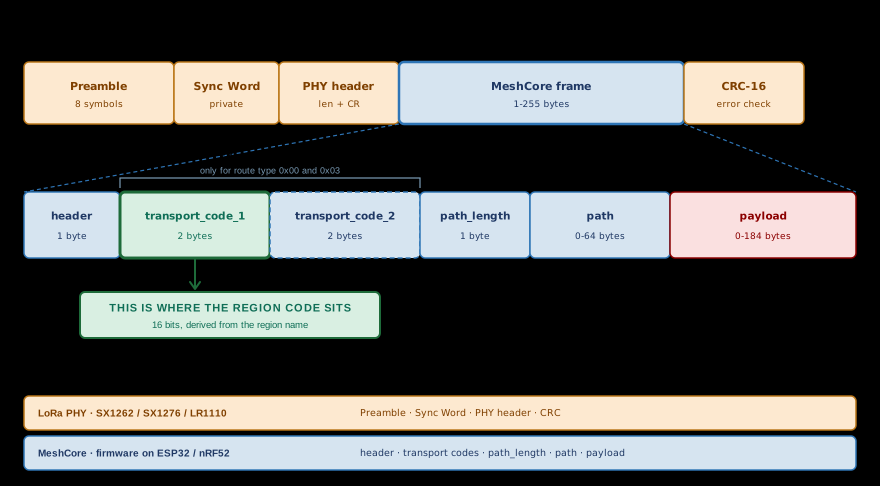
| Layer | Who provides it | Fields | Does MeshCore see this? |
|---|---|---|---|
| LoRa PHY | Radio chip: SX1262, SX1276, LR1110 | Preamble, sync word, PHY header, CRC-16 | No — the chip adds them on transmit and strips them on receive |
| MeshCore | Firmware on ESP32 or nRF52 | header, transport_codes, path_length, path, payload |
Yes — this is the complete picture the firmware gets |
The radio chip is set to the private LoRa sync word (0x12 on the SX127x, the
equivalent register pair on the SX126x). Sync word and CRC are hardware
settings; there is no corresponding MeshCore field.
[!NOTE] Integrity comes from two sides, not from a single MIC field. MeshCore has no separate MIC field. Transport errors are caught by the radio chip's CRC-16; authentication runs through a 2-byte cipher MAC inside the payload. Two different mechanisms, on two different layers.
The wire format
Everything below concerns the MeshCore part — the blue block in the diagram.
[header][transport_codes (optional)][path_length][path][payload]
| Field | Bytes | Description | Layer |
|---|---|---|---|
header |
1 | Route type, payload type, and payload version in a single byte | MeshCore |
transport_codes |
4 (optional) | Two 16-bit codes; present only for the two TRANSPORT route types. This is where the transport code (the scope) sits — see Regions and Scopes | MeshCore |
path_length |
1 | Hop count (bits 0-5) and hash size (bits 6-7) | MeshCore |
path |
0-64 | hop_count × hash_size bytes of node hashes |
MeshCore |
payload |
0-184 | Type-dependent content, see Payloads by type | MeshCore |
| Preamble | 8 symbols | Synchronisation for the receiver | LoRa PHY |
| Sync word | — | Network separation, private sync word | LoRa PHY |
| PHY header | — | Length and coding rate, in explicit mode | LoRa PHY |
| CRC-16 | 2 | Error detection on the radio link | LoRa PHY |
The italic rows are there for completeness: they do travel over the air, but they never reach the MeshCore firmware.
[!NOTE] Limits from the firmware:
MAX_PATH_SIZE= 64,MAX_PACKET_PAYLOAD= 184,MAX_TRANS_UNIT= 255. A packet with a full path and a full payload comes to 254 bytes; anything over 255 is rejected by the dispatcher.
The header byte
One byte, read as 0bVVPPPPRR — V = version, P = payload type,
R = route type. Bit 0 is the rightmost bit.
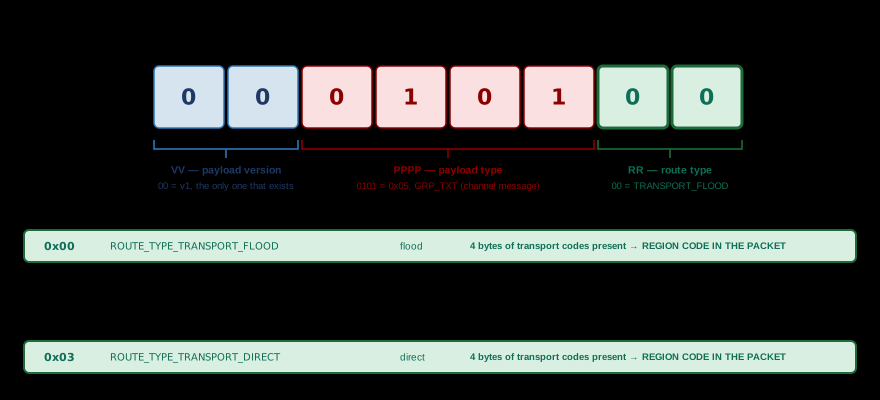
| Bits | Mask | Field |
|---|---|---|
| 0-1 | 0x03 |
Route type |
| 2-5 | 0x3C |
Payload type |
| 6-7 | 0xC0 |
Payload version |
Route type (bits 0-1)
| Value | Name | Meaning |
|---|---|---|
0x00 |
ROUTE_TYPE_TRANSPORT_FLOOD |
Flood with transport codes (so with a region scope) |
0x01 |
ROUTE_TYPE_FLOOD |
Flood without transport codes (unscoped) |
0x02 |
ROUTE_TYPE_DIRECT |
Direct route, path is supplied |
0x03 |
ROUTE_TYPE_TRANSPORT_DIRECT |
Direct route with transport codes |
The two TRANSPORT variants are the only ones that carry the four transport-code
bytes. For ROUTE_TYPE_FLOOD and ROUTE_TYPE_DIRECT they are absent entirely —
the packet is four bytes shorter. Those four bytes hold the transport code; how it is
derived and what a repeater does with it is covered in
Regions and Scopes.
Payload type (bits 2-5)
| Value | Name | Description |
|---|---|---|
0x00 |
PAYLOAD_TYPE_REQ |
Request to a known node |
0x01 |
PAYLOAD_TYPE_RESPONSE |
Reply to REQ or ANON_REQ |
0x02 |
PAYLOAD_TYPE_TXT_MSG |
Text message (direct message) |
0x03 |
PAYLOAD_TYPE_ACK |
Acknowledgement |
0x04 |
PAYLOAD_TYPE_ADVERT |
Node advertising itself |
0x05 |
PAYLOAD_TYPE_GRP_TXT |
Channel message (group text, unverified) |
0x06 |
PAYLOAD_TYPE_GRP_DATA |
Channel datagram (unverified) |
0x07 |
PAYLOAD_TYPE_ANON_REQ |
Anonymous request (login, region query) |
0x08 |
PAYLOAD_TYPE_PATH |
Returned path, optionally with an attachment |
0x09 |
PAYLOAD_TYPE_TRACE |
Path tracing, collecting SNR per hop |
0x0A |
PAYLOAD_TYPE_MULTIPART |
Part of a sequence of packets |
0x0B |
PAYLOAD_TYPE_CONTROL |
Control/discovery, unencrypted |
0x0C-0x0E |
— | Reserved |
0x0F |
PAYLOAD_TYPE_RAW_CUSTOM |
Raw bytes, custom encryption |
Payload version (bits 6-7)
| Value | Version | Meaning |
|---|---|---|
0x00 |
v1 | 1-byte src/dest hashes, 2-byte MAC — the only one that exists today |
0x01-0x03 |
v2-v4 | Reserved for the future |
The dispatcher discards anything above PAYLOAD_VER_1 as unsupported packet
version.
path_length: hop count and hash size
path_length is not a byte count. It packs two things:
| Bits | Field | Range |
|---|---|---|
| 0-5 | Number of hashes in the path (hop count) | 0-63 |
| 6-7 | Hash size minus 1 | see table |
| Bits 6-7 | Hash size | Status |
|---|---|---|
0b00 |
1 byte | Default, also on older firmware |
0b01 |
2 bytes | Supported |
0b10 |
3 bytes | Supported |
0b11 |
4 bytes | Reserved — packet is rejected |
The actual number of path bytes is hop_count × hash_size:
0x00— zero hops, no path bytes0x05— 5 hops with 1-byte hashes → 5 path bytes0x45— 5 hops with 2-byte hashes → 10 path bytes0x8A— 10 hops with 3-byte hashes → 30 path bytes
A node hash is the first byte of that node's public key (the first 2 or 3 bytes in the larger hash modes). It is the same 1-byte identifier described in Private & Public Key Encryption and Route Tracing.
[!WARNING] There is no 4-byte Node-ID in the protocol. Where older DOMCA pages speak of a 4-byte Destination and Source ID in the header, the reality is 1-byte hashes that live in the payload, not in the header.
Payloads by type
The payload starts directly after the path. All 16- and 32-bit integers are little-endian.
ADVERT — 0x04
Unencrypted and signed. This is the packet by which a node exists.
| Field | Bytes | Description |
|---|---|---|
| Public key | 32 | Ed25519 public key |
| Timestamp | 4 | Unix time of issue |
| Signature | 64 | Ed25519 signature over public key ‖ timestamp ‖ appdata |
| Appdata | rest | Maximum 32 bytes, see below |
Appdata:
| Field | Bytes | Description |
|---|---|---|
| Flags | 1 | Node type in the low 4 bits, presence flags in the high bits |
| Latitude | 4 (optional) | Degrees × 1,000,000, integer |
| Longitude | 4 (optional) | Degrees × 1,000,000, integer |
| Feature 1 / 2 | 2 + 2 (optional) | Reserved |
| Name | rest | Node name |
| Flag | Meaning |
|---|---|
0x01 |
Chat node |
0x02 |
Repeater |
0x03 |
Room server |
0x04 |
Sensor |
0x10 |
Contains lat/lon |
0x20 / 0x40 |
Reserved |
0x80 |
Contains a name |
The low four bits are a value, not a bitmask: a repeater is 2, not an
0x02 bit alongside other types.
Encrypted datagrams — 0x00, 0x01, 0x02, 0x08
REQ, RESPONSE, TXT_MSG, and PATH share the same envelope:
| Field | Bytes | Description |
|---|---|---|
| Destination hash | 1 | First byte of the recipient's public key |
| Source hash | 1 | First byte of the sender's public key |
| Cipher MAC | 2 | HMAC-SHA256 over the ciphertext, truncated to 2 bytes |
| Ciphertext | rest | AES-128, block by block, with the ECDH shared secret |
After decryption, for a text message:
| Field | Bytes | Description |
|---|---|---|
| Timestamp | 4 | Send time |
| txt_type + attempt | 1 | Upper 6 bits type, lower 2 bits attempt number 0-3 |
| Message | rest | The text |
| txt_type | Meaning |
|---|---|
0x00 |
Plain text |
0x01 |
CLI command |
0x02 |
Signed text: 4 bytes of pubkey prefix, then the text |
For PATH, the decrypted content holds the returned path plus an optional
piggybacked payload (an ACK, for instance) with its own type byte.
For REQ, a sub-type byte follows the timestamp. This is where everything that
is often mistaken for a separate packet type actually happens:
| Sub-type | Name | Returns |
|---|---|---|
0x01 |
REQ_TYPE_GET_STATUS |
Battery, queues, RSSI/SNR, packet counters, airtime, uptime, error flags |
0x02 |
REQ_TYPE_KEEP_ALIVE |
Keeps a connection alive |
0x03 |
REQ_TYPE_GET_TELEMETRY_DATA |
Sensor data as Cayenne LPP, with permission bits for base, location, and environment |
0x05 |
REQ_TYPE_GET_ACCESS_LIST |
Access list, admins only |
0x06 |
REQ_TYPE_GET_NEIGHBOURS |
A repeater's neighbour table, with sorting and configurable pubkey prefix length |
0x07 |
REQ_TYPE_GET_OWNER_INFO |
Owner details |
Sub-types 0x01 and 0x02 live in BaseChatMesh; the rest are filled in per
node type, in this case by the repeater firmware.
Channel messages — 0x05 and 0x06
| Field | Bytes | Description |
|---|---|---|
| Channel hash | 1 | First byte of SHA-256 over the channel key |
| Cipher MAC | 2 | As above |
| Ciphertext | rest | AES-128 with the channel PSK |
For GRP_TXT the decrypted content uses the same format as a text message, with
name: message as the text. For GRP_DATA there is instead a data type
(2 bytes), a length (1 byte), and the data.
ANON_REQ — 0x07
For when the recipient does not know you yet: the sender includes their entire public key.
| Field | Bytes | Description |
|---|---|---|
| Destination hash | 1 | First byte of the recipient's public key |
| Public key | 32 | The sender's full Ed25519 public key |
| Cipher MAC | 2 | As above |
| Ciphertext | rest | Login, region query, owner info, or clock query |
Sub-types 0x01 (regions), 0x02 (owner info), and 0x03 (clock and status)
carry a timestamp, the sub-type, and a reply path.
ACK — 0x03
| Field | Bytes | Description |
|---|---|---|
| Checksum | 4 | CRC over the timestamp, text, and the sender's public key |
There is no status or error code in it. CLI commands produce no ACK.
TRACE — 0x09
Direct route only. The path is supplied in advance; each hop writes back its measured SNR.
| Field | Bytes | Description |
|---|---|---|
| Tag | 4 | Chosen by the requester |
| Auth code | 4 | For authorised traces |
| Flags | 1 | Low 2 bits: hash size of the supplied path |
| Path | rest | The hashes of the route to follow |
The collected SNR values end up in the packet's path field, as a signed byte
holding SNR × 4.
MULTIPART — 0x0A
| Field | Bytes | Description |
|---|---|---|
| Flags | 1 | High 4 bits: number of remaining parts. Low 4 bits: the actual payload type |
| Data | rest | The payload of that type |
CONTROL — 0x0B
Unencrypted, for discovery.
| Field | Bytes | Description |
|---|---|---|
| Flags | 1 | High 4 bits sub-type: 0x8 = DISCOVER_REQ, 0x9 = DISCOVER_RESP |
| Data | rest | For REQ: type filter, tag, optional since. For RESP: SNR, tag, pubkey or prefix |
RAW_CUSTOM — 0x0F
No defined format. For applications with their own encryption.
Worked out: the transmitted record of a channel message
A channel message is the clearest example, because it carries two independent fields that are often confused: the channel hash and the transport code. They come from different keys and sit in different places in the record. Only the first is an identifier: the channel hash points at a channel and stays constant. The transport code is a signature over this payload and changes with every message — see Regions and Scopes.
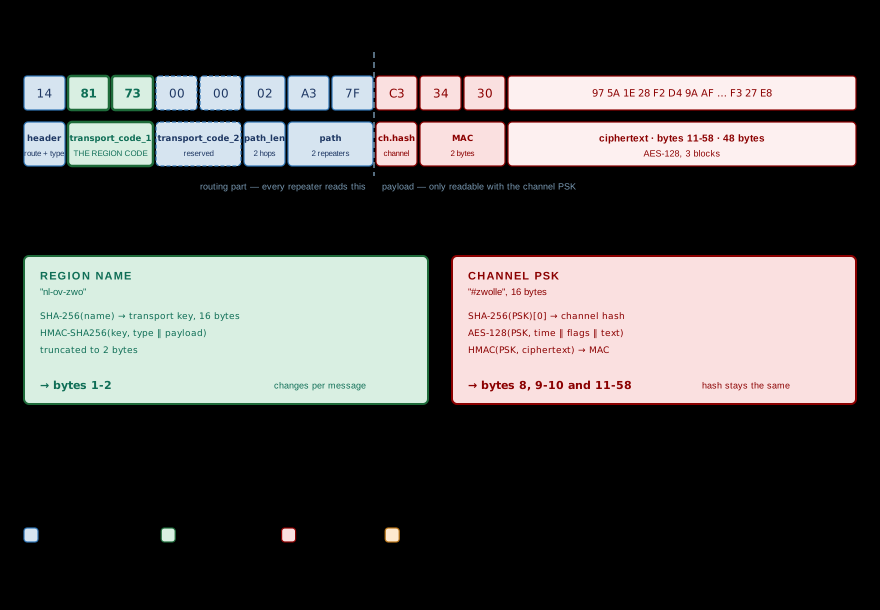
The same thing in table form:
| Byte(s) | Value | Field | Where it comes from | Layer |
|---|---|---|---|---|
| 0 | 14 |
header |
0b00010100: version 0, payload type 0x05 (GRP_TXT), route type 0x00 (TRANSPORT_FLOOD) |
MeshCore |
| 1-2 | 81 73 |
transport_code_1 |
The transport code (scope). HMAC-SHA256 over payload type and payload, keyed from the region name, truncated to 2 bytes. Not a region identifier: it changes per message | MeshCore |
| 3-4 | 00 00 |
transport_code_2 |
Reserved, currently written as zero | MeshCore |
| 5 | 02 |
path_length |
2 hops, 1-byte hashes → 2 path bytes follow | MeshCore |
| 6-7 | A3 7F |
path |
Appended by the two repeaters that passed the packet on | MeshCore |
| 8 | C3 |
Channel hash | First byte of SHA-256 over the #zwolle channel PSK |
MeshCore, payload |
| 9-10 | 34 30 |
Cipher MAC | HMAC-SHA256 over the ciphertext with the PSK, truncated to 2 bytes | MeshCore, payload |
| 11-58 | 97 5A 1E … |
Ciphertext | AES-128 with the PSK over timestamp, flags, and "PE1HVH: Op Woensdag a.s. Blauwvingerdagen" |
MeshCore, payload |
59 bytes of MeshCore frame in total. Around it the radio chip still adds the preamble, sync word, PHY header, and CRC — those are not counted in these 59.
Bytes 1-2 are the most interesting here, and they get their own chapter: Regions and Scopes covers how that code is derived, why it changes per message, and how a repeater filters on it.
Sources
- MeshCore firmware —
docs/packet_format.md - MeshCore firmware —
docs/payloads.md - MeshCore firmware —
docs/cli_commands.md - MeshCore firmware —
src/Packet.h - MeshCore firmware —
src/helpers/RegionMap.cpp - MeshCore firmware —
src/helpers/TransportKeyStore.cpp
Translated from Dutch by Anthropic Claude